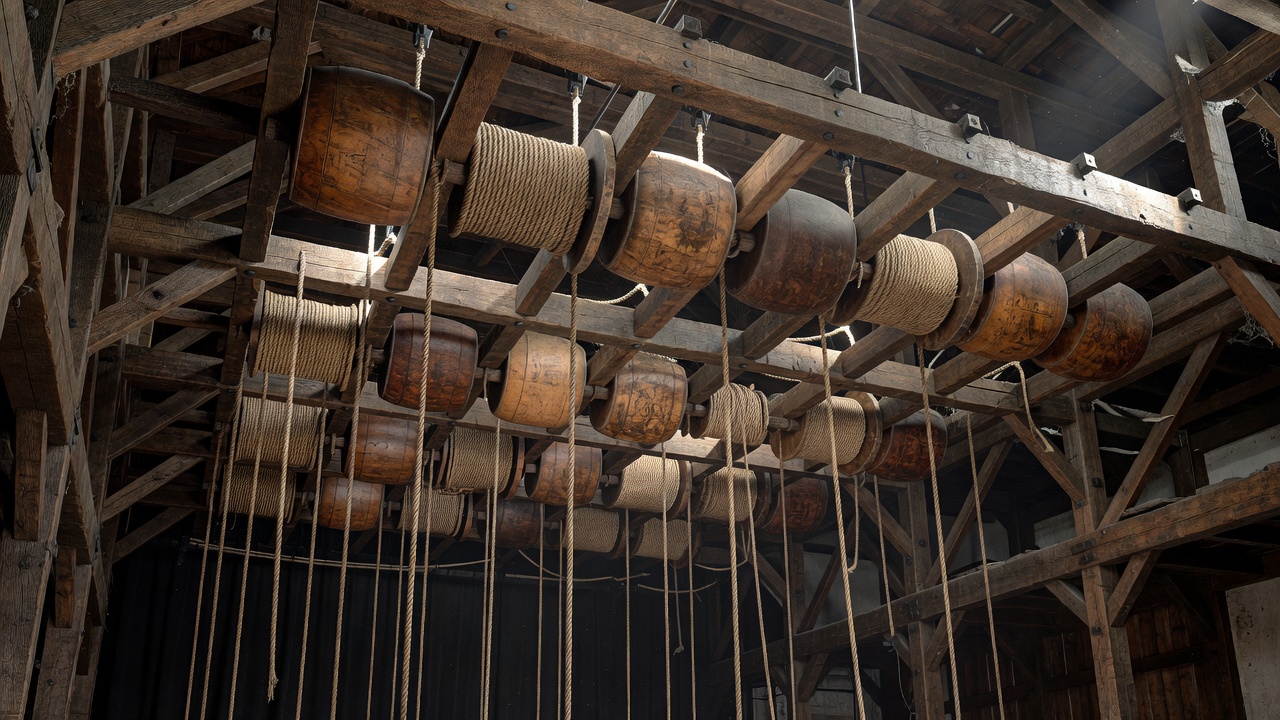
What survives: more than a collection of parts
A surviving drum may look like an isolated object until its relationship to a shaft, rope route and stage opening is reconstructed. Begin by recording the system spatially. Note supports, bearings, redundant fixings, numbering and evidence of alteration. Keep the distinction between an observed feature and an inferred function explicit. A neat diagram should not make an uncertain reconstruction appear certain.
The Drottningholm Palace Theatre in Sweden and the Baroque Theatre at Český Krumlov Castle are important reference points because historic stage technology survives in relation to its architectural setting. Their published histories demonstrate that machinery, scenery and performance practice can form a connected ensemble. They do not provide a universal specification for another theatre. Different construction, maintenance histories and operating arrangements require different judgments.
Include the people who understand the building now. A stage technician may recognise an altered rope path; an archivist may identify a former stage opening in a production photograph. Record oral accounts with permission, attribution and a date. Treat recollection as evidence to examine alongside physical traces, rather than as a substitute for investigation.
What changes: separate preservation from operation
A mechanism can deserve retention without being suitable for use. Before discussing reinstatement, distinguish static conservation, unloaded demonstration and operation under production conditions. These are different activities with different hazards. The decision belongs to an appropriately qualified team that understands both historic fabric and current theatre engineering responsibilities.
In a UK context, the Lifting Operations and Lifting Equipment Regulations 1998 and the Provision and Use of Work Equipment Regulations 1998 may be relevant, depending on equipment and use. EN 17206 addresses machinery for stages and other production areas. A standard is not a certificate that an old installation is safe, and conservation significance does not remove statutory duties. Establish the applicable requirements with competent advisers.
Do not test an undocumented installation by loading it or asking a volunteer to operate it. Existing supports, hidden metal fatigue, rope condition and changes to the building may all matter. Survey access itself needs a safe method. This article deliberately gives no operating or repair instructions: those depend on the actual equipment and a formal assessment.
Compare interventions before choosing one
Where live production needs new lifting capacity, an independent modern system may reduce repeated demands on significant historic equipment. Yet new beams, fixings and service routes can themselves cause harm. Compare complete schemes, including inspection access and eventual removal, rather than judging only the visible equipment. Reversibility is a useful aim, not a promise that every intervention can be undone without consequence.
| Approach | Possible benefit | Question to resolve |
|---|---|---|
| Static retention | Protects material and spatial relationships | How will deterioration be monitored? |
| Limited demonstration | Communicates movement and technique | What assessed limits and supervision apply? |
| Separate modern installation | Supports contemporary production needs | What fabric, loads and access does it affect? |
The Tyne Theatre & Opera House and the Gaiety Theatre on the Isle of Man are useful British reference points for studying the public interpretation of surviving stage technology. Read the theatres’ own accounts before drawing parallels. The existence of a working example elsewhere does not establish that a different installation should be returned to use.
What gets recorded: a system the next team can read
Give significant components stable identifiers and connect them to measured drawings, photographs and condition notes. Record materials, observed wear, previous repairs and inaccessible areas. Before dismantling, document sequence and orientation using a method agreed with the conservation team. Loose components need labelled storage and a traceable relationship to their former positions.
At handover, retain assessment reports, approvals, operating restrictions and maintenance responsibilities alongside the conservation record. Note exactly which components are new and why they were introduced. If movement has been recorded on film, preserve a written description as well: video may show an action clearly while concealing load paths or an operator’s judgment.
Our editorial position is that conserving machinery means conserving the possibility of understanding it. Sometimes that leads to carefully managed operation; sometimes to stillness. In both cases, the project should leave less ambiguity about what survives, what is safe and what a future custodian must check.
Reference points
- Drottningholms Slottsteater — institutional history and theatre context.
- Český Krumlov Castle — official visitor information on the Baroque Theatre.
- Health and Safety Executive — work equipment and lifting guidance.
- Tyne Theatre & Opera House and VillaGaiety — venue histories and heritage information.
References identify relevant institutions and frameworks; they do not imply endorsement or a project partnership.